
Historical / Deutschland
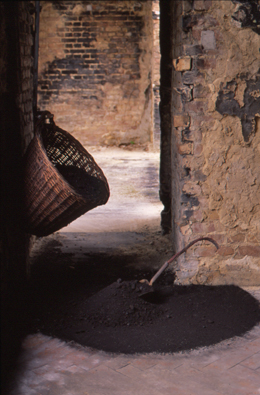
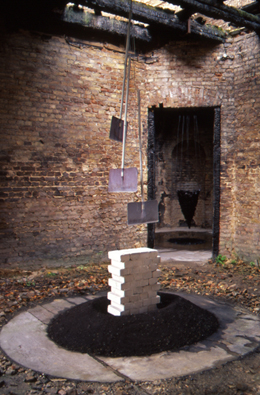
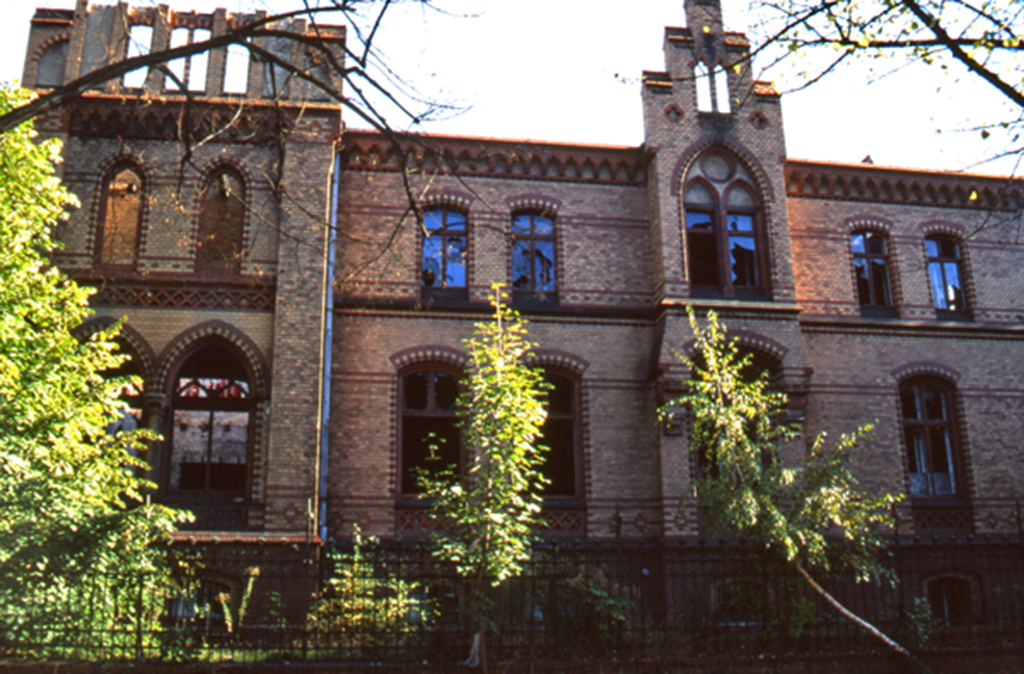
A fire-damaged Officers’ Casino at a former East German military base (Deutsche Demokratische Republik / DDR) in Potsdam became the site for One Day Four Hours. Rumored to have been deliberately burned after Wiedervereinigung (reunification) to destroy property records, the building revealed a charred interior where material process could register institutional erasure as visible record.
The title refers to the alleged destruction timeline and the narrow four-hour window during which the site was accessible. Where documents were burned to erase administrative memory, the installation worked through material—coal, copper wire, decomposed paper, water, and sound—to record by physical means.
The work was not an assemblage imposed upon the site, but a direct engagement with fragments of a charged military and bureaucratic structure of significance to the citizenry. Collection, discovery, and extraction were open-ended rather than predetermined. Each point of engagement—placement, erosion, suspension, accumulation—was identified by material, context, and vulnerability. Together, sixteen discrete works coalesced into One Day Four Hours: a cumulative exposure to the remnants of history, informed by analysis yet grounded in the raw, time-worn matter of the site itself.
While oriented toward historical erasure, the installation also looks forward. The building’s later conversion into a kindergarten introduces a suspended condition—history acknowledged but not repeated; absorbed, then reopened to new rhythms. The work occupies this interval between past and future, attending to what persists, what transforms, and what may be inferred without attempting reconstruction.
Pendulum
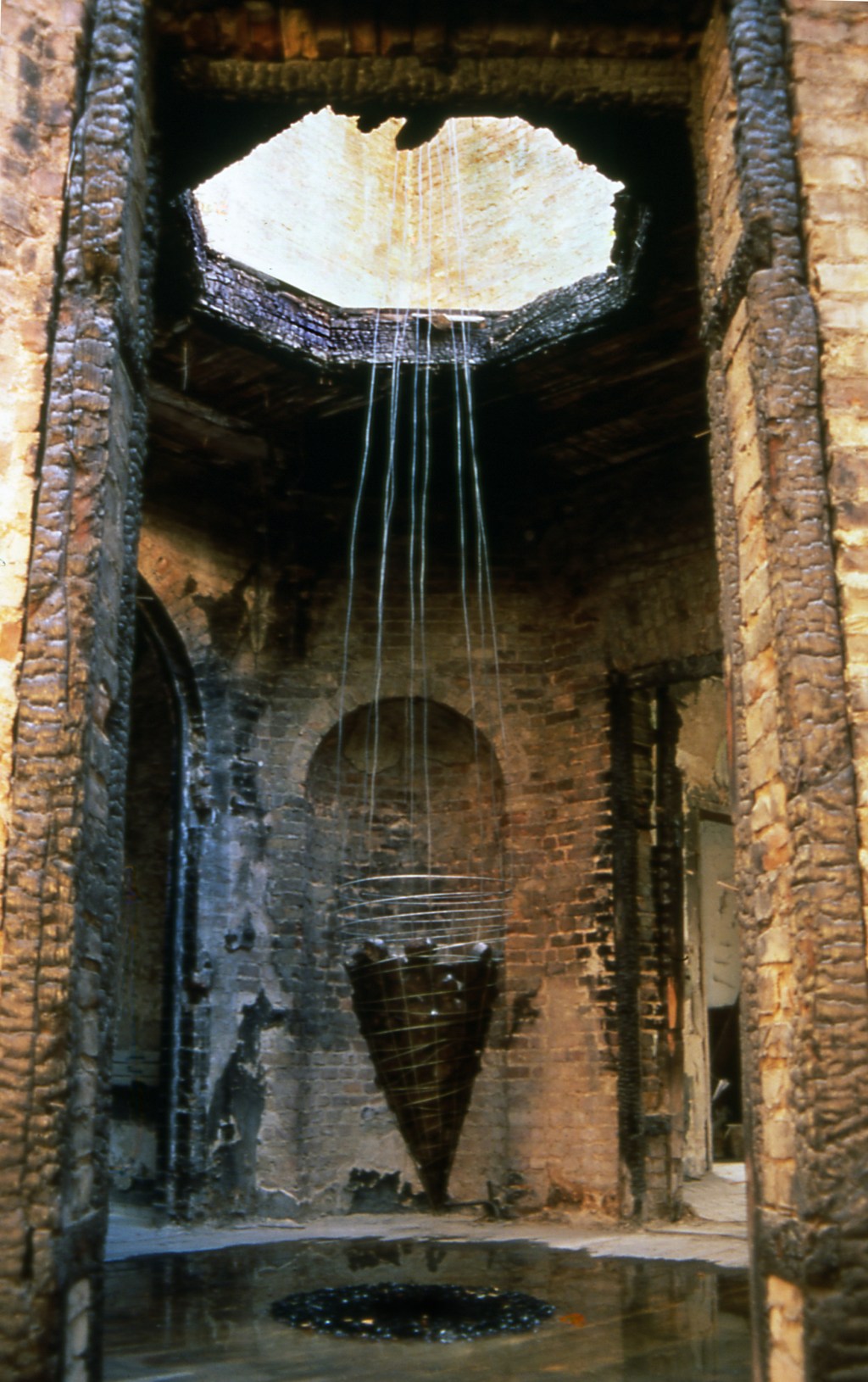
Suspended in the main hall, Pendulum transforms the ruin of administrative erasure into a slow, material clock. A conical galvanized-wire structure cradles dozens of lignite briquettes—the low-grade coal that once powered the DDR’s economy. Rainwater passes through the porous fuel, dripping rhythmically onto an ashen disk below. Each drop carries trace minerals, staining the long-plank hardwood floor and registering gradual disintegration.
In the DDR, lignite functioned as both necessity and ideology. It sustained a nation isolated from hard coal reserves while producing extensive environmental damage—deforestation, drained wetlands, poisoned rivers, and acid rain driven by sulfur dioxide emissions. Following reunification, the industry collapsed abruptly. Within the former officers’ casino, the suspended coal structure steadily releases humic acid and sulfated water (SO₄²⁻), marking time through dissolution rather than measure.

Tug of War
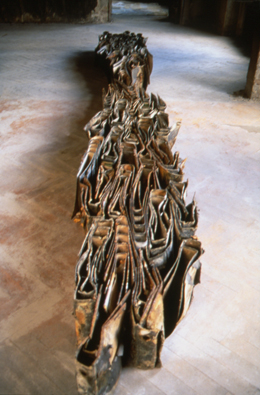
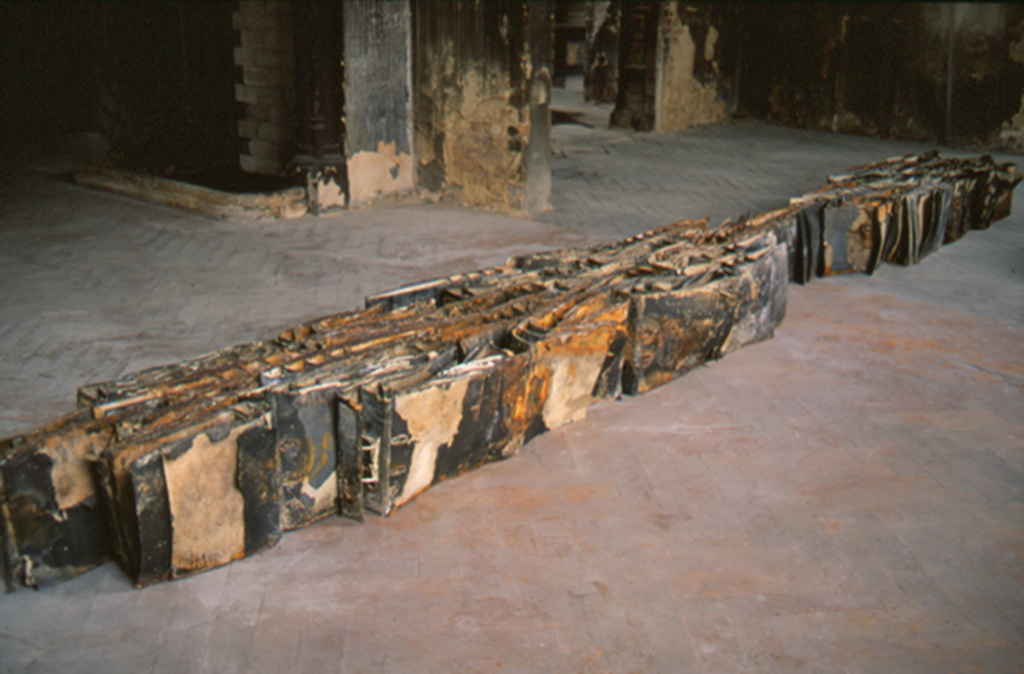
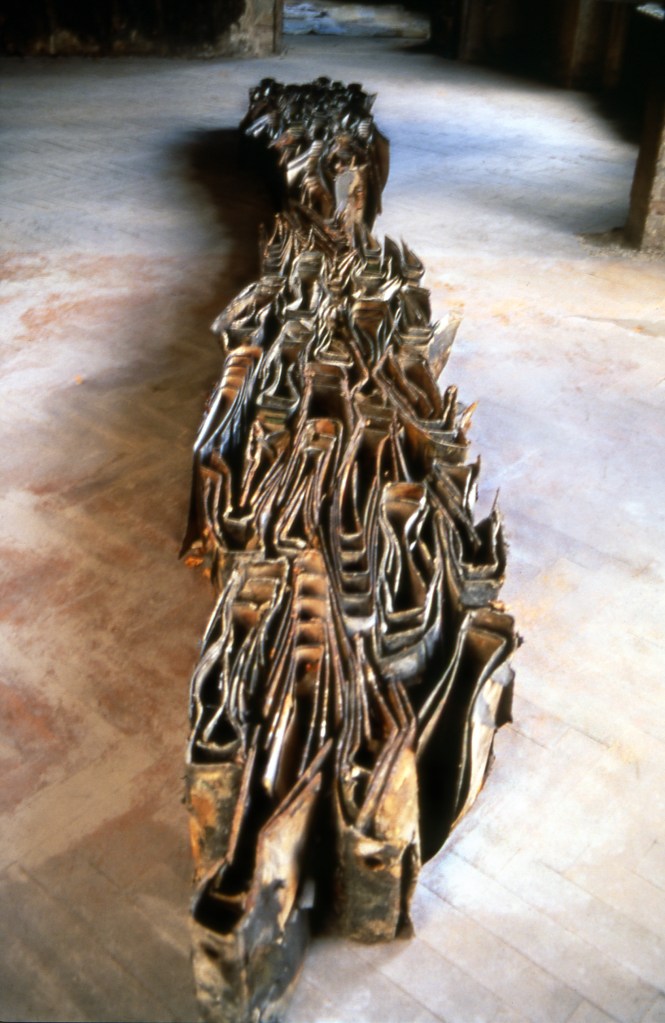
Across the floor, hundreds of charred document binders form an interlocking east–west pattern. Burned spines, emptied of content, create a fragile field of administrative remains—an archive undone by fire. Visitors move cautiously through the space, aware that even minimal disturbance threatens collapse.

Transition
Ouroboros

Lineage
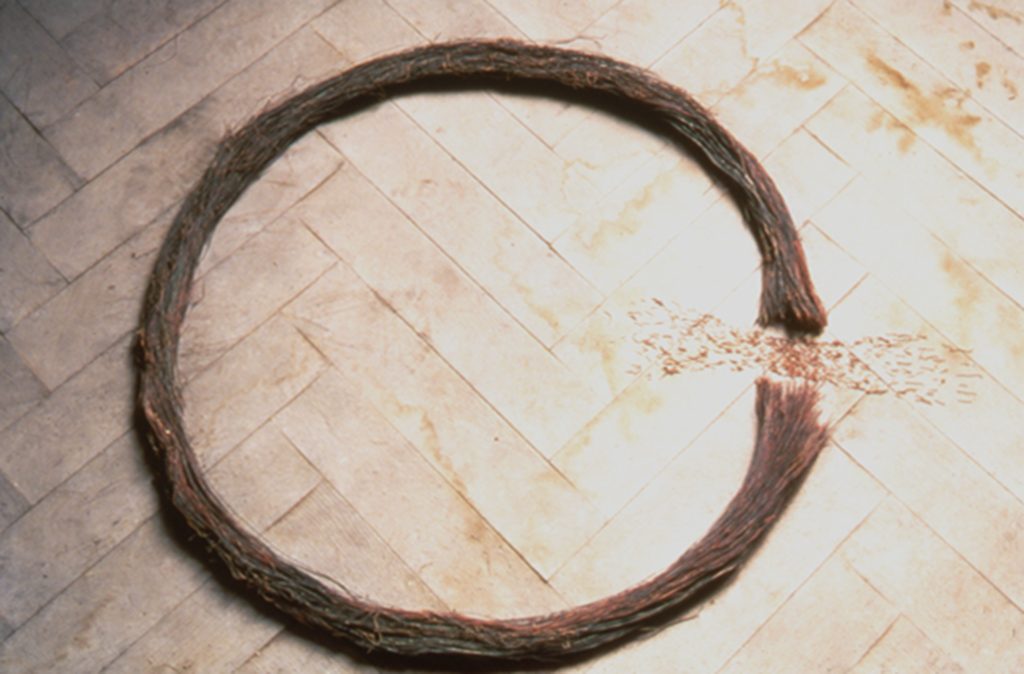
Three copper–wire installations—Transition, Ouroboros, and Lineage—are laid directly on the herringbone floors using heat-damaged and oxidized copper wire. Transition forms fragmented linear patterns; Ouroboros describes a circular path with a deliberate 100mm rupture; Lineage arranges parallel wire segments into measured intervals. Across all three works, the copper bears multiple states simultaneously—heat-darkened surfaces, red–brown oxidation, and emerging green patinas—registering chemical exposure, thermal stress, and time-based transformation against the surviving wood floor.


Ronda
A galvanized steel bathtub is mounted high beneath an open–roof section, collecting rainwater that forms a reflective pool. The manufacturer’s stamp—Ronda—remains visible along the rim, marking a trace of industrial production left intact within the ruin while the vessel passively collects hydrochemical drift as evidence.

Whisper
An angled glass tube, suspended by oxidized copper wire, channels ambient sound across a water-damaged wall. Rain, echoes, and air movement are redirected, revealing the altered acoustics of the structure through subtle amplification.

Muros
Fire-damaged administrative papers recovered from the building are distributed throughout the space. Scorched, yellowed, and partially illegible, they persist only as fragmented records—material evidence of documentation undone. ▧
One Day Four Hours, 1997
Edward Dormer
Public art, installation
Schiffbauergasse (Kindertagesstätte Zauberstein), Potsdam, Brandenburg Deutschland
Presented by: Galerie Markus Richter, Potsdam
In-kind support: Sebastian Gäbel, Heidi Weiss, Jennifer Mann, Lea Yeager, L.E.G. Landeshauptstadt Potsdam
⌬
⌬⌬
A limited-edition artist’s book produced following the site’s demolition. Eleven copies were created—one held in the United States, the remaining ten in Deutschland. Eleven photographs were hand-printed using specialized solutions and dyes, mounted on heavy archival board, and bound within a burned cover that mirrors the installation’s charred interior. The book functions as a material rearticulation of One Day Four Hours, extending the work through archival construction rather than preservation.
Circum., 1998
Limited edition artist book, edition of 11
Printing: Elena Bouvier, SoJane Press
 LUCARNE